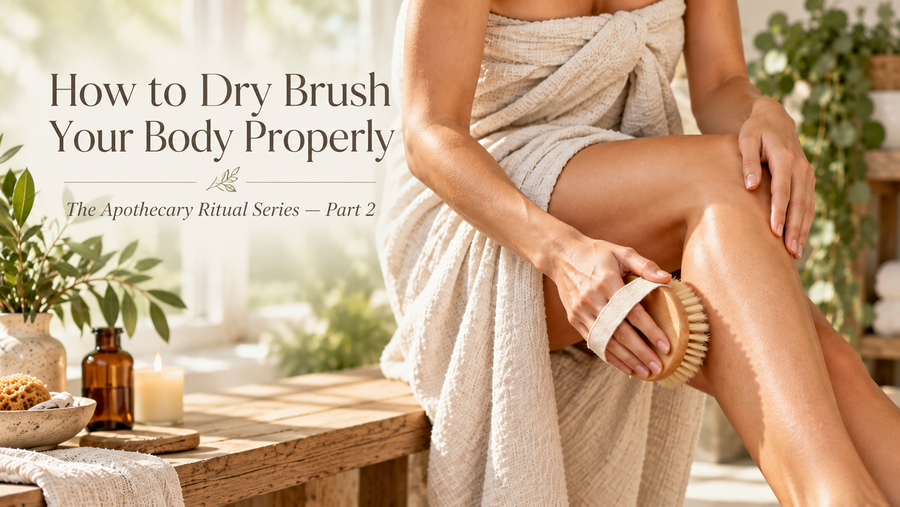
How to Dry Brush Your Body Properly: A Complete Step-by-Step Guide
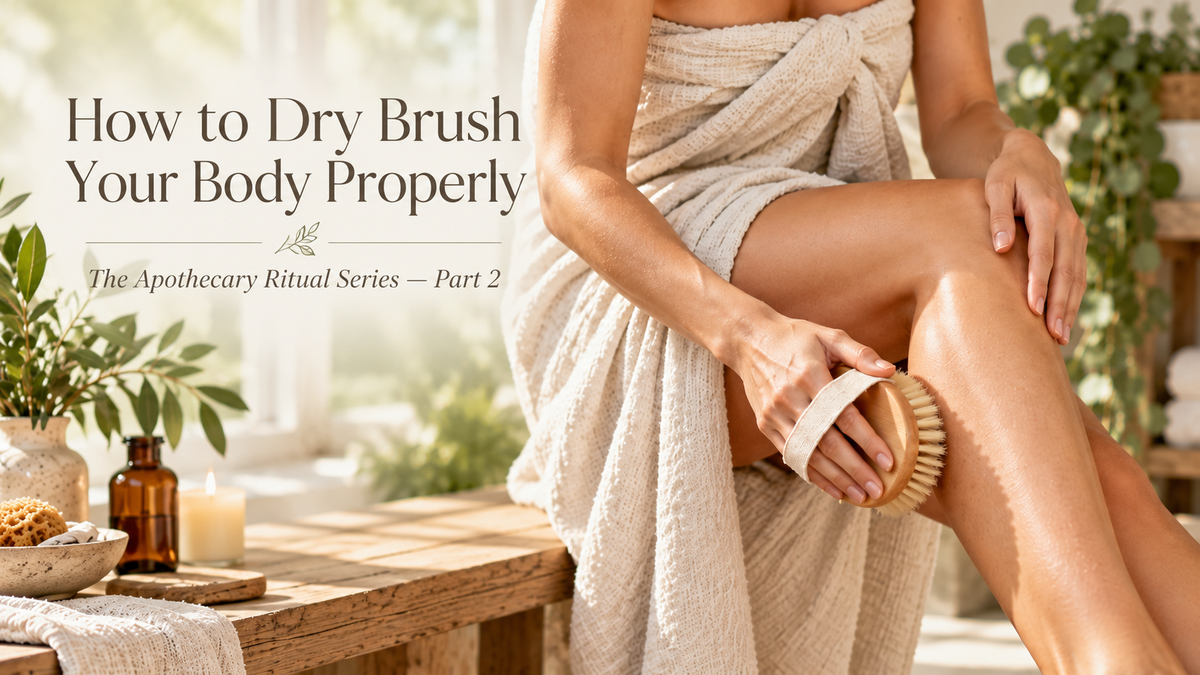
How to Dry Brush Your Body Properly: A Complete Step-by-Step Guide
The Apothecary Ritual Series — Part 2
Dry brushing has become a beloved part of many body-care rituals, but more pressure and more brushing are not necessarily better.
At its simplest, dry brushing is a form of mechanical exfoliation performed by moving a dry body brush over dry skin.
The practice can help remove loose, flaky surface skin and leave your skin feeling smoother.
The secret is learning how to do it without damaging your skin barrier.
Welcome to Part 2 of The Apothecary Ritual Series by Natalie’s Naturals Apothecary.
What Does Dry Brushing Actually Do?
Your skin naturally sheds dead surface cells.
Dry brushing provides gentle mechanical exfoliation that can help loosen some of those surface cells before bathing.
People often notice that their skin feels smoother immediately afterward.
You may also notice temporary warmth or pinkness because brushing stimulates the skin's surface.
However, dry brushing is frequently associated online with claims that go far beyond what we actually know.
It should primarily be considered a skin-care and self-care ritual, not a medical detoxification treatment.
Does Dry Brushing Detox the Body?
You'll often hear that dry brushing “removes toxins.”
That description isn't medically accurate.
Your body already has highly specialized systems involved in waste removal and processing, including your liver, kidneys, lungs, digestive system and lymphatic system.
Dry brushing doesn't physically brush toxins out through the skin.
That doesn't mean it can't be enjoyable.
It simply means we can appreciate dry brushing for what it actually offers: exfoliation, sensory stimulation and an intentional moment of body care.
What You Need
Choose a body brush with bristles that feel firm enough to exfoliate but not sharp or painful.
Natural-bristle brushes are popular, although the most important consideration is how your individual skin tolerates the brush.
A long handle can make it easier to reach the back of your body.
Keep the brush clean and allow it to dry completely between uses.
When Should You Dry Brush?
One of the easiest times is immediately before taking a shower or bath.
Both your skin and brush should be dry.
Afterward, you can rinse away loosened surface skin and apply moisturizer.
How Much Pressure Should You Use?
Start much lighter than you think you need.
Dry brushing should feel stimulating but comfortable.
You should not be scratching yourself.
Your skin may become mildly pink for a short period, but intense redness, scratches, burning or persistent irritation means you are brushing too aggressively.
The goal is exfoliation.
Not abrasion.
Step 1: Begin at Your Feet
Start at one foot and ankle.
Using long, smooth strokes, brush upward toward your lower leg.
Make approximately 2 to 4 gentle passes over each section.
Avoid rapidly scrubbing back and forth.
Switch feet and repeat.
Step 2: Brush Your Lower Legs
Begin near the ankle.
Use long upward strokes toward your knee.
Work around the front, sides and back of the lower leg.
Think:
Ankle → Knee
Keep your strokes smooth and controlled.
Step 3: Brush Your Thighs
Begin near the knee and work upward toward the upper thigh.
Again, use long strokes rather than short, aggressive scrubbing.
Reduce pressure over sensitive inner-thigh areas.
Step 4: Brush Your Hands and Arms
Start at your hands.
Move from:
Hands → Wrists → Forearms → Elbows → Upper Arms
Use gentle strokes moving upward along the arm.
Avoid excessive pressure over delicate areas.
Step 5: Brush the Abdomen
The skin over your abdomen may be more sensitive than your legs.
Use lighter pressure here.
Slow circular movements are generally more comfortable than aggressive strokes.
Do not press deeply into your abdomen.
Step 6: Brush Your Back
A long-handled brush makes this area easier to reach.
Use controlled, comfortable strokes.
You do not need to aggressively scrub your spine or repeatedly brush one section.
Step 7: Chest and Décolletage
The skin over the upper chest and décolletage is thinner and often more sensitive.
Use considerably lighter pressure.
Avoid aggressive brushing over breast tissue, nipples or any particularly sensitive area.
Areas You Should Avoid
Never dry brush directly over irritated or damaged skin.
Avoid:
Open wounds.
Cuts or abrasions.
Sunburn.
Active skin infections.
Inflamed rashes.
Painful acne lesions.
Active eczema or psoriasis patches unless approved by your healthcare professional.
Recently shaved skin that is already irritated.
Suspicious or raised skin lesions.
Dry brushing should also not be used as a substitute for medical treatment of swelling or skin disease.
Can You Dry Brush Your Face?
A traditional body dry brush is generally too aggressive for facial skin.
If you want to exfoliate your face, choose a product or technique specifically designed for facial skin.
Your facial skin does not need the same type of brushing used on your legs or arms.
How Long Should You Dry Brush?
A full routine doesn't need to take long.
For most people:
Approximately 3 to 10 minutes is enough.
Spending longer doesn't necessarily improve your results.
Repeated aggressive exfoliation can weaken the skin barrier and leave your skin dry or sensitive.
What Should You Do After Dry Brushing?
Shower
Rinse your skin with comfortably warm or lukewarm water.
Very hot showers can contribute to dryness.
Cleanse Gently
You've already exfoliated.
You generally don't need to immediately follow dry brushing with another aggressive body scrub.
Pat Dry
Gently pat your skin dry rather than vigorously rubbing with your towel.
Moisturize
Apply your favorite body moisturizer, balm or body oil.
Applying moisturizer while your skin is still slightly damp can help trap water in the skin and support softness.
How Often Should You Dry Brush?
There is no universal schedule.
Sensitive or dry skin may tolerate dry brushing only once or twice per week.
Other people may tolerate it more frequently.
Start conservatively.
Your skin will tell you whether you're doing too much.
If you notice increased dryness, itching, irritation or sensitivity, decrease your frequency or take a break.
Does Dry Brushing Get Rid of Cellulite?
Dry brushing does not permanently remove cellulite.
Temporary stimulation and skin plumping may make the surface of the skin look slightly smoother immediately after brushing.
That should not be confused with permanently changing the underlying structures responsible for cellulite.
Enjoy the ritual for skin care — not for unrealistic promises.
Common Dry-Brushing Mistakes
One of the most common mistakes is applying far too much pressure.
Other common issues include:
Brushing irritated skin.
Brushing the same section over and over.
Using a dirty brush.
Following dry brushing with another harsh exfoliant.
Ignoring signs that your skin barrier is irritated.
Dry brushing should make your skin feel refreshed, not injured.
The Ideal Dry-Brushing Ritual
Think:
Dry Brush → Shower → Pat Dry → Moisturize
Simple rituals are often the easiest ones to maintain.
You don't need twenty steps to make body care meaningful.
Continue The Apothecary Ritual Series
Previous: Part 1 — How to Perform Self-Lymphatic Drainage Massage
Learn the gentle pressure, direction and sequence used for a general self-care lymphatic massage routine.
Next: Part 3 — How to Use a Gua Sha Stone Properly
Learn how to glide your facial gua sha tool correctly without tugging or aggressively scraping your skin.
From the Apothecary
After exfoliating, give freshly brushed skin the nourishment it deserves.
Follow your shower with a botanical body balm or oil and take a moment to massage it slowly into damp skin.
Explore Natalie’s Naturals Apothecary →
Educational Disclaimer: This article provides general skincare and wellness education and is not intended to diagnose or treat any medical condition. People with chronic skin conditions, unexplained swelling, circulation concerns or other medical conditions should consult an appropriate healthcare professional before beginning a new body-care practice.